





Document Management in the Face of the Explosion of Unstructured Data
Traditional document management systems were designed for limited volumes and relatively uniform formats. However, companies today must:
- Process a growing volume of incoming documents (emails, PDFs, scans, photos, handwritten documents)
- That are mostly unstructured,
- Come from multiple channels,
- And vary widely in quality.
Traditional systems struggle to handle this complexity without significant human intervention.
⚠️ KEY INSIGHT
According to Gartner, 80 to 90% of corporate data is unstructured!
Traditional tools were built for storage, not understanding
Electronic document management (EDM) systems and “traditional” OCR solutions allow users to organize, index, or archive documents, but they remain largely incapable of understanding the business context of those documents. As soon as documents move beyond strictly structured formats, manual data entry becomes necessary again, leading to errors, delays, and hidden costs.
⚠️ KEY INSIGHT
The issue is no longer storage, but understanding the content.

“Companies need to adapt their data management strategies in order to extract more value from unstructured data”
IDC – Worldwide Global DataSphere Structured and Unstructured Data Forecast, 2024–2028
What is Intelligent Document Processing (IDP)?
Intelligent Document Processing (IDP) combines multiple AI technologies (deep OCR, natural language processing, FullText, LLM, vLLM, etc.) to automatically understand and leverage the content of documents, regardless of their format or level of structure. Unlike traditional tools that simply archive data, IDP extracts key data, validates it, and formats it to meet the standards required by your IT systems.
⚠️ KEY INSIGHT
IDP transforms unstructured content into controlled, actionable information.
Why are companies adopting IDP on a massive scale?
Companies are increasingly adopting IDP for its immediate impact on operational efficiency and customer experience:
- Reduced processing times (from hours to seconds) aligned with modern digital expectations
- Ability to handle volume spikes with the same staff levels
- Automated controls for business rules, fraud detection and regulatory compliance
- Freeing employees to focus on value-added tasks (expertise, customer relations)
- Complete traceability and end-to-end compliance
Beyond the immediate benefits, implementing the IDP within the organization also addresses a structural challenge: doing more, faster, with fewer resources, while meeting increasingly stringent compliance requirements and combating document fraud. In many industries, automating document processing is becoming essential for business continuity, particularly during periods of peak activity or workforce shortages.
⚠️ KEY INSIGHT
IDP does more than just automate; it enhances the reliability and streamlines the processing of documents.
How does IDP transform the value of document data?
By automating the extraction, verification, and structuring of information, IDP enables a shift from an archiving approach to a data-driven approach. Reliable document data becomes accessible in real time and can feed into management systems, dashboards, or workflows. The document is no longer a constraint, but a source of value.
By structuring data derived from documents, IDP also paves the way for advanced AI applications. This data can be used in semantic search engines, business assistants, or RAG (Retrieval-Augmented Generation) systems, ensuring responses based on reliable and up-to-date information. IDP thus becomes a vital link between documentation, data, and artificial intelligence.
⚠️ KEY INSIGHT
Reliable, comprehensive, real-time data in your IT systems and AI = better decisions.

“Data is the fuel for processes and AI: if it isn't reliable from the outset, neither business systems nor AI can produce reliable results.”
Practical use cases for IDP
IDP can be adapted to a wide range of departments and processes. It automates repetitive tasks while ensuring a high level of accuracy.
In benefits departments, it ensures the reliability of reimbursements. In compliance teams, it facilitates compliance. In customer management, it streamlines administrative tasks and enhances the customer experience through faster and more seamless interactions.
Examples of use cases:
- OCR for dental, optical, and ophthalmological quotes
- Automatic scanning of alternative medicine invoices
- Automatic verification of bank account numbers (RIB/IBAN)
- Contract analysis and classification
- Verification, analysis, and summarization of accident photos
- Verification of ID cards and passports (KYC / onboarding process)
- Data extraction, sentiment analysis, and summarization of handwritten letters
-
Processing of HR documents (resumes, forms, certificates)...
⚠️ KEY INSIGHT
AI is pushing the boundaries of document analysis. Even the most complex cases—such as handwritten documents, free-form text, photos, and unstructured multi-page tables—can now be processed automatically.
Criteria for choosing an IDP solution
Not all IDP solutions are created equal. Some are designed exclusively for processing identity documents, while others cover a wide range of areas: banking, income, civil status, residence, business, healthcare, automotive, and more. Some are limited to extracting information, while others verify, format, and enrich it (or summarize it as needed—for example, handwritten letters or multi-page contracts). Some rely on “all-LLM” approaches, while others use multi-AI systems...
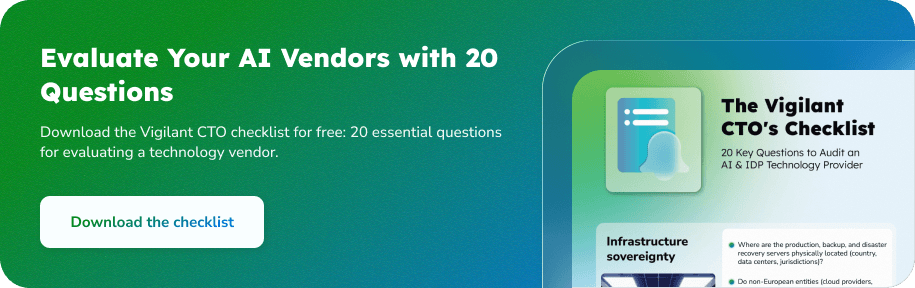
So how do you choose an intelligent document processing solution? It depends on several factors: extraction accuracy, a catalog of pre-configured documents, ease of integration with existing tools, scalability, and security. It is also important to evaluate the user experience and the solution’s ability to adapt to specific business needs and learn new document workflows.
⚠️ KEY INSIGHT
Extraction performance is no longer enough. By 2026, data quality, sovereignty, security, and efficiency have become key criteria.
The Future of Document Management with AI
The rapid evolution of AI is accelerating the transition to intelligent, context-aware, and proactive document management. Systems are no longer limited to extracting information; they are capable of understanding a document’s context, identifying risky situations, suggesting actions, or automatically triggering complex business processes.
In the medium term, document intelligence is expected to become a standard component of information systems, just like ERP or BPM. It will play a key role in ensuring the reliability of AI assistants by providing them with verified, traceable, and actionable document data.
This development also raises new challenges in terms of governance, security, and compliance. Companies will need to ensure that documents processed by AI comply with regulatory frameworks and that processing chains remain auditable. IDP thus emerges as a foundational framework for balancing performance, trust, and compliance.
⚠️ KEY INSIGHT
In the future, systems will no longer simply process documents; they will anticipate and guide action.
Conclusion
IDP marks a paradigm shift: it is no longer just about storing documents, but about managing the information they contain. Organizations that adopt these technologies gain in efficiency, agility, and decision-making capabilities. With IDP, document management evolves from a cost center into a strategic business asset.







%20(1).png?noresize&width=374&height=230&name=ressource_fiche%20pratique_checklist_AITECA%20(2)%20(1).png)